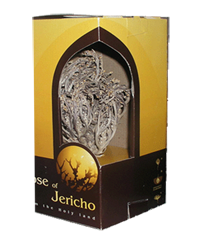
ROSE OF JERICHO
Legends of the Sands: The Mystique and Folklore of the Rose of Jericho

Jul
The vast, silent deserts of the ancient world have given rise to countless myths. In these arid landscapes, where water represents life and dry winds bring isolation, the Rose of Jericho (Anastatica hierochuntica) emerged as a symbol of cosmic mystery. Known to travelers, crusaders, and nomadic tribes across antiquity, this extraordinary plant created a bridge between the physical realities of survival and the supernatural world of miracles.
The Wanderer’s Compass and Desert Ovens
In the folklore of Bedouin tribes and desert nomads, the Rose of Jericho was often viewed as a gift from the sky, a living compass of sorts. Travelers moving across trackless dunes would observe these dried, spherical plants tumbling across the sand, driven by the desert winds.
When a storm approached or rain was imminent, the moisture in the air would cause the tumbling plants to slow down and uncurl right where they landed. Finding a group of opened Roses of Jericho was a reliable indicator to ancient wanderers that water had recently pooled in that area or that a localized downpour was arriving, making the plant a revered harbinger of life-saving rain.
The Legend of the Unfading Bloom
Throughout medieval Europe, returning crusaders brought back marvelous tales of the Levant, alongside botanical treasures from the East. The Rose of Jericho quickly became a staple of medieval bestiaries and herbal lore.
One popular legend claimed that the plant grew in the footsteps of angels and would never truly die. It was whispered that a home containing a Rose of Jericho would be entirely immune to the devastating effects of lightning strikes, plagues, and robberies. The plant was integrated into European family traditions, where it was treated as a sacred talisman, brought out from velvet boxes only during moments of intense family crisis, severe illness, or during the arrival of a new child to ensure protection and cosmic favor.
The Metaphor of the Hidden Heart
In Eastern poetic and mythological traditions, the unique structure of Anastatica hierochuntica inspired deep artistic metaphors. Poets wrote of the plant as an emblem of the “hidden heart.” When dry and closed, the plant appears rough, thorny, dead, and uninviting—representing a person hardened by the trials, droughts, and sorrows of life.
Yet, the myth emphasizes that the plant’s core remains soft and protective of its inner treasure. All it requires is a single drop of compassion—represented by water—to reveal its hidden design and expand into its true purpose. This enduring piece of folklore continues to inspire writers and thinkers, proving that the Rose of Jericho is far more than a simple desert weed; it is a timeless mirror of the human condition.
Questions & Answers
-
Question: Where did the name “Rose of Jericho” come from if it doesn’t look like a typical rose?
-
Answer: The term “Rose” was often used in antiquity to denote any highly prized or beautiful botanical rarity, while “Jericho” symbolized one of the oldest continuously inhabited oasis cities, associated with abundance amidst the desert.
-
-
Question: Are there any ancient texts that mention the plant?
-
Answer: While precise botanical names were not used, many scholars believe that ancient references to “rolling things before the whirlwind” in Near Eastern texts refer directly to the tumbling habit of the dry Rose of Jericho.
-
Related posts: